What is my PMOS/PCOS type?
Discover the different types of PMOS/PCOS and how they can manifest in each individual. Learn how to identify your unique PMOS/PCOS symptoms and treatments.
Sumayyah Elkhouly, Intern & Dr. Abrar Al-Shaer, PhD, RD ·
What is PMOS/PCOS in women?
Polycystic Ovarian Syndrome, most commonly known as PMOS/PCOS, is a genetic, reproductive, metabolic, and hormonal disorder. Women with PMOS/PCOS often experience the following symptoms: acne, excessive hair growth in unwanted places, infertility, blood sugar problems such as insulin resistance and/or diabetes, irregular menstrual cycles, and cysts on the ovaries. Although the Internet often simplifies this condition and makes PMOS/PCOS seem like it’s a condition with a one-size-fits-all solution, PMOS/PCOS is actually really complex and varies from person to person. Therefore, you shouldn’t expect your PMOS/PCOS to look the same or to be treated in the same way as someone else you may know that also has PMOS/PCOS. The goal of this blog is to help you understand the complexity of PMOS/PCOS, and to encourage you to write your own PMOS/PCOS story, a story individualized to your unique symptoms, struggles, and experiences.
What is the reproductive cycle?
Before we talk about the way that PMOS/PCOS affects your body, we need to understand how the female reproductive cycle normally works. First, it is so important to remember that day 1 of your reproductive cycle is actually the first day of menstruation. Many people think that their period is the end of their cycle. However, the first day of your period is the result of shedding your uterine lining from the previous cycle, and is therefore the start of a brand new cycle. We are shedding the old and starting anew!
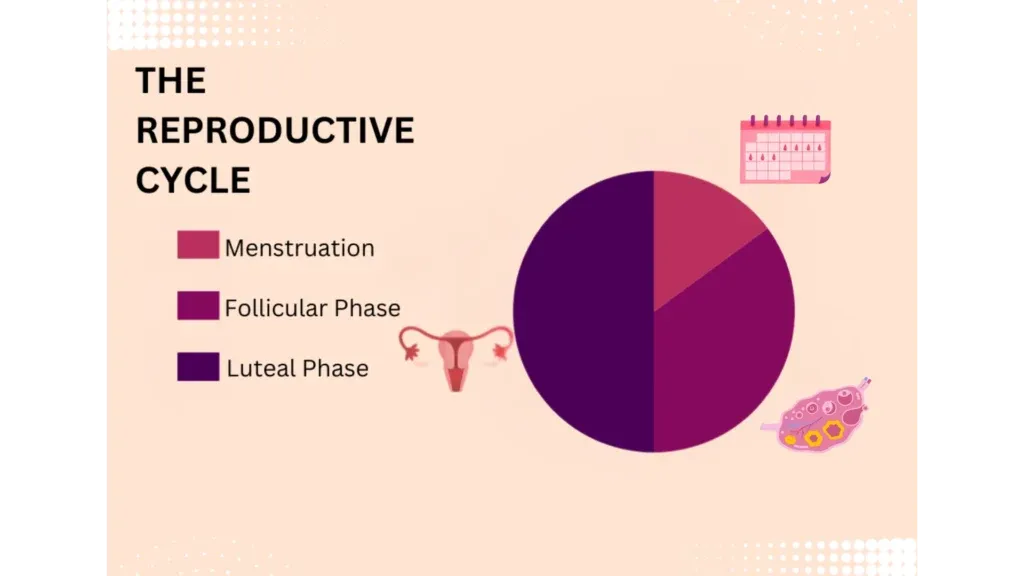
The reproductive cycle in women is made up of two phases: the follicular phase and the luteal phase. So to make things simple, let’s assume a 28-day cycle.
That would mean that days 1-13 are what’s considered the “follicular phase”.
Then day 14 is ovulation day, or basically the day your egg is released and ready to potentially get fertilized (make a baby). Keep in mind that ovulation does not always occur on day 14 of the cycle, and ovulation can vary by 1 or 2 days each cycle.
And lastly, days 15-28 are the “luteal phase”.
To start your reproductive cycle, your brain makes two hormones called follicle stimulating hormone (FSH) and luteinizing hormone (LH). In the follicular phase, your body’s main goal is to prepare your egg for its big day. Your egg is surrounded by a follicle. You can think of the follicle as the eggshell around the egg that feeds it so that the egg can grow properly during this phase. FSH and LH work together to make sure that the follicle that surrounds the egg is healthy and develops correctly. With the help of these two hormones, the egg reaches a point where it is fully mature and ready to be released from the follicle. When the egg reaches this place where it is prepared to pop out, a hormone called estrogen increases really high in your body to push the egg out of the ovary, an event known as ovulation. Now, the egg is waiting for its chance to become fertilized, which is when the egg and the sperm meet to make a baby.
After ovulation, your body prepares a comfortable nest for the egg in case of fertilization and pregnancy. A hormone called progesterone is needed to create this happy, healthy home. Progesterone adds the final touches to this nest, and makes sure that the nest is perfectly furnished for the incoming egg. This takes place during the luteal phase of the reproductive cycle. After progesterone has prepared the nest, your body waits to see whether or not fertilization will happen. In the case of no fertilization (no pregnancy), progesterone and the rest of your hormones decrease, and this triggers your body to shed the comfortable nest that has been made. This results in menstruation, and your cycle begins once again on day 1.
We know this is a lot of information, so if you’d like a more simplified explanation of the reproductive cycle, check out the following blog article: Understanding Your Period: A Simple and Visual Guide.
So, what causes PMOS/PCOS?
PMOS/PCOS is a really complex condition that is unfortunately misunderstood by a lot of people. We would like to first establish that in many women, PMOS/PCOS doesn’t just result from one single cause. Sometimes, these causes are more easily controlled, and your PMOS/PCOS may be improved by making certain lifestyle changes. However, in some cases, your PMOS/PCOS is largely out of your control. No matter how well you eat and how much you exercise, your symptoms might not improve. And in many cases, women have a mix of both, where there are some factors they can control and other factors they don’t have control over.
Because of this, it is important to discuss the role that genetics play on PMOS/PCOS. All women with PMOS/PCOS have some genetic factor that leads to their PMOS/PCOS, otherwise they wouldn’t have it to begin with, but some women’s genetics play a bigger role than others. The main takeaway here is that PMOS/PCOS really can’t be simplified because it doesn’t usually stem from the same cause across the board. Instead, PMOS/PCOS should be viewed as a spectrum of different presentations and symptoms.
The following three causes and presentations are the most common ones that we see in our patients, although some other PMOS/PCOS presentations do exist. We work with our patients to figure out if there are other factors involved in their specific type of PMOS/PCOS and how to best heal accordingly.
LH Steals the Spotlight: PMOS/PCOS and the Reproductive System
When you have PMOS/PCOS, your reproductive cycle does not work as it normally should (as described above). Due to genetic factors, your brain has a miscommunication with your body and releases more LH than what is considered normal. Also, FSH is not produced in large enough amounts to make sure that the follicle that surrounds the egg grows properly. As a result of this, the follicle does not mature, and the egg cannot be released. For some women, this is the primary cause of their PMOS/PCOS.
Essentially, in this type of PMOS/PCOS, LH levels are too high and FSH levels are too low. This prevents many women from ovulating, or releasing their monthly egg. This is a factor that may lead to the infertility common in some PMOS/PCOS patients. Higher LH levels also drive the overproduction of androgens (male hormones) like testosterone and androstenedione, which also block ovulation and make it more difficult to conceive and have a period.
All Eyes on Insulin: PMOS/PCOS and Insulin Resistance
In some cases, PMOS/PCOS may be caused by certain lifestyle habits. If this is the cause of your PMOS/PCOS, managing your condition can be possible with specific lifestyle changes. These lifestyle interventions include blood sugar control, exercising, eating more fiber, increasing your protein intake (and eating more plant-based protein), and reducing your stress levels. For some women, additional factors like sleep, gut health, and immune health also play a role.
Let’s take a quick look at how the hormone insulin works in your body. When you eat carbohydrate-rich foods, such as fruits, vegetables, grains, and more, your body breaks down this food into a type of sugar called glucose. Glucose is so important for your body because it is the primary source of energy for all of your cells, especially the cells of your brain and nervous system. This means that your brain and the rest of your nervous system can’t work properly without enough glucose in the body!
After your food is broken down into glucose, you naturally have sugar (glucose) in your blood. This causes your blood sugar levels to rise a little bit, which is normal and happens every time you eat. Your body then releases a hormone called insulin. Insulin is responsible for making sure that your blood sugar remains stable throughout the day and does not increase too high. Sometimes though, the way that we eat our carbs can cause our blood sugar to rise really high.
Imagine if, one day, you decided to fill your car’s gas tank with syrup instead of gasoline. Just as your car absolutely will not work properly if the fuel source is changed, your body can’t handle your blood having syrup in it. However, this is exactly what happens when your blood sugar levels increase too much during what’s called a blood sugar spike. It is as if there is syrup in your blood. Because of this, your body reacts by releasing a lot of insulin to bring down your blood sugar levels as a way to compensate.
Your body is able to compensate for blood sugar spikes very well, and it often takes several years for the effects of this compensation to show. This cycle of having really high sugar levels in your blood and then having a lot of insulin released after that can eventually become a condition called insulin resistance. In insulin resistance, your cells don’t really respond to insulin anymore, and glucose is not taken up by your cells as effectively.
Stress, the Star of the Show: Cortisol and PMOS/PCOS
Many people don’t realize that stress can actually be a cause of PMOS/PCOS. When you are always stressed out, your body makes more of a hormone called cortisol, which is naturally produced by the body during certain parts of the day. You may have heard of this hormone before on social media or in other health blogs or magazines, and you may even associate negative things with cortisol. However, this is a really important hormone because it helps you wake up and stay alert. When you are experiencing high-stress periods in your life, your body is going to make more cortisol than it normally would to allow you to be more alert and pay more attention to any potential threats. As you can imagine, it is really tiring for your body to regularly be scanning your life for threats. If your cortisol levels are always increasing and decreasing, this puts your body on edge at all times.
Think about this scenario: imagine yourself in the middle of a dark forest, in which you must constantly scan your surroundings for threats. In this case, your body wants to make sure that you are able to respond appropriately to any and all dangerous situations. Because you are on edge, your cortisol levels increase. Also, your blood sugar levels increase, because your body wants to make sure that you are prepared to run (or react accordingly) in the face of danger. This cycle of raising your cortisol and blood sugar levels continuously causes a lot of problems with blood sugar balance and insulin. This can lead to your body becoming insensitive to insulin, which can lead to insulin resistance driven by stress.
The PMOS/PCOS Spectrum: Why Every Woman Is Different
So far, we have discussed the most common causes and presentations of PMOS/PCOS that we see in our practice. However, patients often have mixtures of these three specific presentations, because PMOS/PCOS is rarely isolated in its cause. Here are a few examples to highlight the complexity of PMOS/PCOS in real life patients.
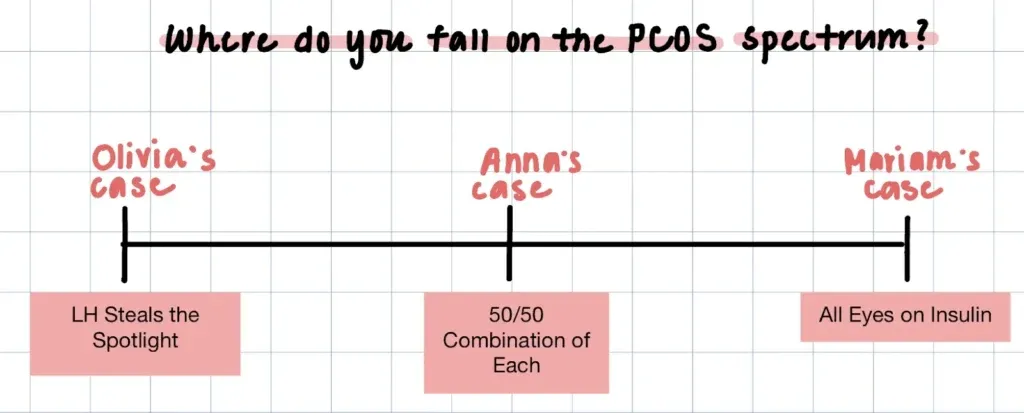
- Olivia: A patient who presented with a classic example of PMOS/PCOS caused by high LH levels. Working on blood sugar balance alone did not improve her PMOS/PCOS symptoms, demonstrating the role of her genetics on PMOS/PCOS. Instead, when we combined approaches that help to target LH and lower her testosterone, that’s when things started to improve.
- Anna: A patient who had about a 50/50 distribution of both high LH and high insulin. Sometimes, she felt more affected by her symptoms related to her reproductive cycle, whereas other times her metabolic symptoms were more severe.
- Mariam: A patient who presented with a classic example of PMOS/PCOS insulin resistance. Lifestyle interventions, such as working on blood sugar balance and improving diet quality, helped her manage her PMOS/PCOS symptoms.
This spectrum illustrates the three primary PMOS/PCOS presentations: LH-driven, insulin-resistant, and a combination of both. Understanding where you fall can help guide more personalized nutrition, lifestyle, and herbal support strategies.
In Summary:
- Polycystic Ovary Syndrome symptoms include acne, excessive hair growth in unwanted places, infertility, insulin resistance, irregular menstrual cycles, and cysts on the ovaries. This is a condition that may stem from genetic, reproductive, metabolic, and hormonal factors.
- One major way in which PMOS/PCOS affects the female body is through the reproductive cycle, in which certain hormone levels can be either too high or too low.
- PMOS/PCOS can stem from a genetic predisposition, from lifestyle factors, or from stress. Because there are different causes of PMOS/PCOS, the way that PMOS/PCOS manifests in each woman varies as well.
- The three most common presentations of PMOS/PCOS stem from 1) elevated LH, 2) increases in insulin production by the body, and 3) high stress levels. Although often advertised as such on the Internet, PMOS/PCOS is not a condition that looks the same for everyone. Instead, you should view PMOS/PCOS as a spectrum of varying symptoms.
- PMOS/PCOS treatment should be tailored to you. Treatment specific to your PMOS/PCOS type will be the most effective way to manage your symptoms.
- Please keep in mind that if you are missing your periods or experiencing irregular menstrual cycles, PMOS/PCOS is not the only potential contributor.
References
- Dapas, M., Lin, F. T. J., Nadkarni, G. N., Sisk, R., Legro, R. S., Urbanek, M., Hayes, M. G., & Dunaif, A. (2020, June 23). Distinct subtypes of polycystic ovary syndrome with novel genetic associations: An unsupervised, phenotypic clustering analysis. Retrieved June 20, 2024, from PubMed
- Zhao, Y., Fu, L., Li, R., Wang, L.-N., Yang, Y., Liu, N.-N., Zhang, C.-M., Wang, Y., Liu, P., Tu, B.-B., Zhang, X., & Qiao, J. (2012, November 30). Metabolic profiles characterizing different phenotypes of polycystic ovary syndrome: plasma metabolomics analysis. Retrieved June 20, 2024, from NCBI
- Khan Academy: The Reproductive System Series