Is there a way to reduce blood sugar levels immediately?
Why blood sugar balance matters for hormones like insulin, and how to reduce blood sugar spikes and manage insulin resistance.
Sumayyah Elkhouly, Intern & Dr. Abrar Al-Shaer, PhD, RD ·

Why blood sugar balance?
Good blood sugar health is so important for achieving overall health and wellbeing, and is vital for developing and maintaining good hormone health. If you find yourself experiencing any of the following symptoms or conditions, then blood sugar balance may be especially beneficial for you!
- Fatigue and decreased energy levels
- Sugar cravings
- Hot flashes
- Constantly fluctuating weight
- Period pain and PMS/PMDD
- Endometriosis
- PMOS/PCOS
- Insulin resistance
- Diabetes
- Chronic inflammation
What is blood sugar balance?
You may have heard about this concept of balancing your blood sugar, but what does this actually mean? Firstly, let’s identify some of the key players in this blood sugar balance game.
Key player #1 → What is glucose?
Glucose is a type of sugar that your body absorbs from the breakdown of carbohydrate-rich foods like fruits, vegetables, pasta, rice, corn, potatoes, sweets, and more. This glucose is then used as an energy source for your body, fueling many of the activities that you take part in every day. Because of this, we do need glucose in our bodies at all times. Fun fact: your brain and nervous system actually use about a quarter of all of the glucose that you eat every single day, making them the biggest glucose consumers in your entire body! Therefore, carbs are not bad, as the Internet makes them seem. They are actually crucial for our survival. The nuance is all in how we eat our carbs, not just in whether or not we choose to eat them.
Key player #2 → What is insulin?
Insulin is a hormone that your body releases after you eat to control the glucose levels in your blood. When you eat, your body naturally breaks down your carbohydrate-rich foods into glucose, causing an elevation in your blood sugar levels. This elevation is a normal response to eating. Insulin is then released by your body to help the glucose get absorbed by your body’s cells for fuel. In this way, insulin helps to stabilize your blood sugar levels throughout the day.
What is insulin resistance?
When glucose is absorbed properly by your cells in response to insulin, there is no issue, and the body is working exactly as it should be! So, how can this balance game be disturbed? Imagine you eat a giant bowl of fruit salad and nothing else. This fruit salad will cause your blood sugar levels to rise, and rise, and rise even more, causing an elevation in your blood sugar values that are much higher than what your body is used to dealing with. This is known as a blood sugar spike, and when this happens, your body sends out a lot more insulin to compensate. If this happens over and over again, every day for a long time, then eventually your cells are going to begin ignoring the call of insulin, and glucose will not be absorbed by your cells. If glucose is not being taken up by your cells to use in the making of energy, this means that glucose will stay in your blood for longer periods of time after you eat.
Think about it like this: if someone knocks on your door once, you will go and open the door for that person. But, if you hear continuous knocking, maybe because of construction happening somewhere near your home, over and over and over again in a rather annoying way, you are likely to eventually just ignore this completely. Also, you’re likely to drown out this sound, and not pay attention to it anymore. This is exactly what happens when your body experiences blood sugar spikes. Insulin knocks on the door of your cells, so that they can open up and take the glucose from your blood. But, over time, if insulin is always being released, your cells begin to ignore the knocking of insulin and they are no longer sensitive to the signals that insulin sends to them. This is also known as insulin resistance. It is important to know insulin resistance and PMOS/PCOS are highly correlated with one another.
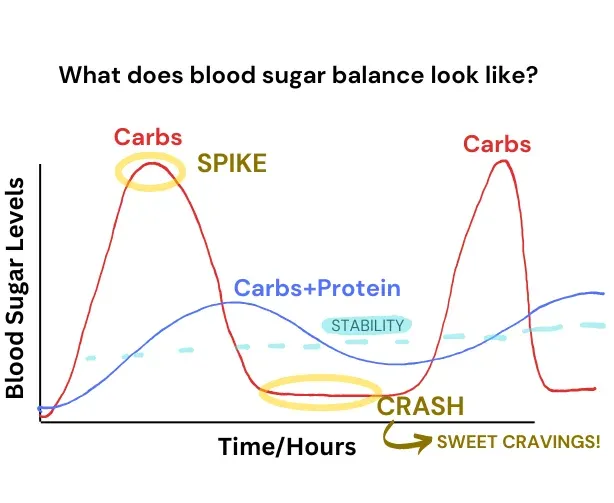
How can you balance your sugar levels?
So, is eating that big bowl of fruit salad a bad thing? Not at all! As we talked about earlier, you should change your focus to how you eat your carbs, and stop thinking of carbs as the culprit.
The key to this is blood sugar balance. Although it may sound complicated, balancing your blood sugar is not a difficult task to achieve! Think of it as simple fixes that you can begin incorporating immediately that will have significant, positive impacts on your blood sugar levels. The following are a few easy, natural ways to lower your blood sugar and to work on overall blood sugar balance.
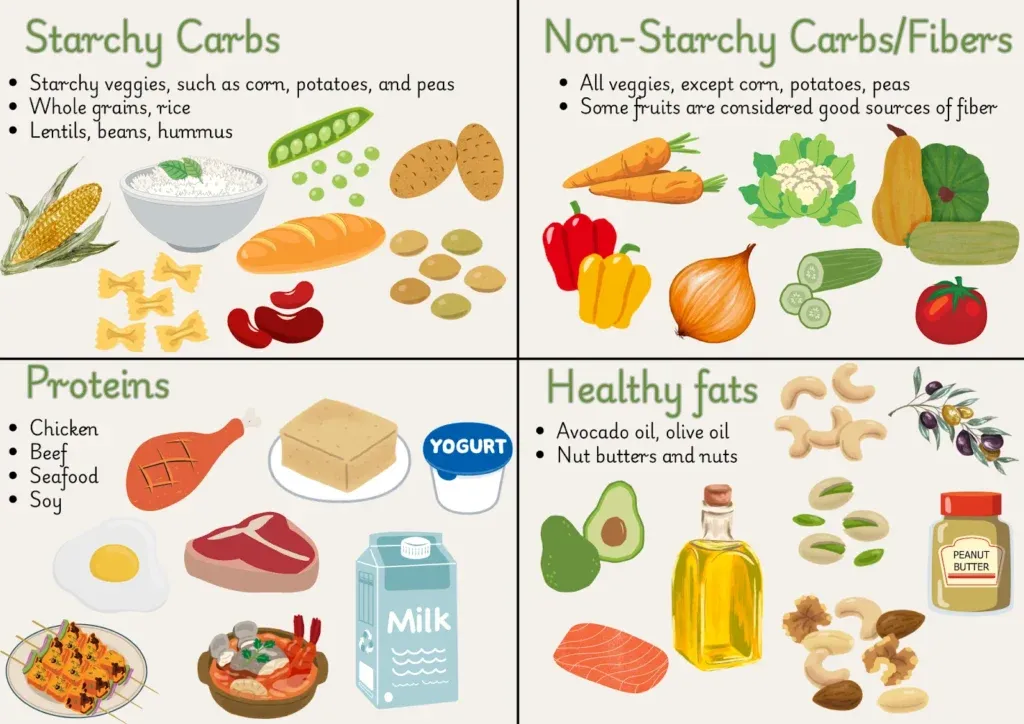
Eat Non-Starchy Vegetables First
When eating a meal, try to eat your non-starchy vegetables first, followed by proteins and healthy fats, and then lastly, consume your carbohydrates. The non-starchy vegetables are pretty much any vegetable other than corn, peas, and potatoes. So, for example, if you have a plate of salad, rice, and chicken, eat your salad first, and then your chicken, and after this, have your rice (it’s okay if you eat your chicken with your rice at the same time if you prefer!). Eating your veggies/salad first acts as a mesh lining for your digestive tract, and helps your carbohydrates absorb more slowly in your body, which prevents large blood sugar spikes. Think of a faucet, with the water representing carbohydrates. When you turn the faucet on, the water flows quickly with no barrier. But, if you were to put a mesh cloth over the faucet and then turn it on, the water trickles through the mesh cloth much more slowly. This is the example of eating your vegetables and salads before your carbohydrates.
Next, increase your protein intake! For meals, aim to get 20-30g of protein and for snacks try to get 7-10g when you’re eating a more carb-dense food like sweets or lots of fruits. Keep in mind that protein does not only come from animals. There are many ways to get protein from plant sources as well. You’d be surprised that one serving of pumpkin seeds has more protein than one egg!
Animal and Seafood Protein Sources
| Food (cooked) | Serving Size | Protein (g) |
|---|---|---|
| Chicken, skinless | 3 oz (size of your palm) | 28 |
| Steak | 3 oz (size of your palm) | 26 |
| Turkey, roasted | 3 oz (size of your palm) | 25 |
| Fish such as Herring, Tuna, Salmon, Tilapia, etc | 3 oz (size of your palm) | 17-25 |
| Lamb | 3 oz (size of your palm) | 23 |
| Pork | 3 oz (size of your palm) | 22 |
| Sardines | 3 oz (size of your palm) | 21 |
| Shrimp | 3 oz (size of your palm) | 20 |
| Lobster/Scallops | 3 oz (size of your palm) | 16 |
| Egg, large | 1 egg | 6 |
Plant Protein Sources
| Food | Serving Size | Protein (g) |
|---|---|---|
| Yellow Soybeans (cooked)* | ½ cup | 14 |
| Soy nuts | ¼ cup | 12 |
| Green Soybeans/Edamame (cooked)* | ½ cup | 11 |
| Pinto Beans (cooked)* | ½ cup | 11 |
| Tofu | 3 oz, size of your palm | 10 |
| Pumpkin/Hemp seeds | ¼ cup | 9 |
| Adzuki beans/Lentils (cooked)* | ½ cup | 9 |
| Black beans/Red Kidney beans (cooked)* | ½ cup | 8 |
| Peanuts/Peanut or almond butter | 2 tbsp | 7-8 |
| Chickpeas/Fava beans (cooked)* | ½ cup | 7 |
| Almonds/Pistachios | ¼ cup | 6 |
| Flax/Sunflower seeds | ¼ cup | 6 |
| Lima Beans (cooked)* | ½ cup | 6 |
| Wheat berries/Kamut (cooked)* | ½ cup | 6 |
| Chia seeds/Cashews | ¼ cup | 5 |
| Walnuts | ¼ cup | 4 |
| Quinoa/Amaranth (cooked)* | ½ cup | 4 |
*These also contain carbs, so if you’re eating them in combo with other carbs (like beans + rice) you will need additional protein from another food to balance.
Dairy Products
| Food | Serving Size | Protein (g) |
|---|---|---|
| Greek yogurt, plain | 1 cup | 17 |
| Cottage/Ricotta cheese | ½ cup | 14 |
| Milk (also contains carbs) | 1 cup | 8 |
| Soy milk (also contains carbs) | 1 cup | 8 |
| Cheese (mozzarella, cheddar, provolone, etc) | 1 oz or 1 slice | 7 |
| String cheese | 1 piece | 7 |

Note: the practice receives 15% of sales made through the Fullscript links in this post, which covers the overhead of maintaining our Fullscript dispensary page and practice.
Additional Tips for Balancing Blood Sugar
- Take a 10-20 minute walk after a meal. When you move, your muscles quickly uptake more glucose from your bloodstream into your cells, which decreases the glucose sitting in your blood. This prevents a large spike after eating.
- Inositol is a plant nutrient that your body actually makes on its own in small amounts. It is also found in some foods, including fruits, grains, legumes, and meats, but again, only in small amounts. Inositol can be used to help you balance your blood sugar and manage other symptoms, such as high cholesterol, high blood pressure, infertility, and insulin resistance. The amount of inositol your body makes and the amount you get from foods is not enough to actually cause a change to your health. The therapeutic dose of inositol is 2000 mg of a mix between two subtypes of Inositol, myoinositol and chiro inositol, twice a day. It can be taken as a supplement, as research shows that the average American diet only contains 1 gram of inositol per day. You can find inositol on our Fullscript page.
Blood Sugar Monitors
A Continuous Glucose Monitor (CGM) can be a helpful tool to track your blood sugar levels throughout the day. This device is particularly beneficial in showing you your blood sugar levels upon waking (known as your fasting blood glucose), as well as showing you how certain foods affect your blood sugar. You may notice that particular foods or meals will cause a higher elevation in your blood sugar than others, and this information can be extremely helpful in teaching you how your body reacts to some foods versus others. It is incredibly important to remember that each person may respond differently to the same type of food or meal. Also, additional factors such as sleep, stress, exercise, and fiber and protein intake impact your blood sugar levels, and this will be demonstrated by the CGM as well.
My Experience Wearing a CGM
I wore a CGM for ten days, and I found the experience to be very insightful, educational, and intriguing. In these ten days, I learned a lot about how my body reacts to the food that I consume on a regular basis, and I also learned how to adjust my food intake in order to better support my health and my body’s needs. The following are my main takeaways from this experience:
- Protein is SO important! I thought I was eating enough protein throughout the day, but it turns out that I was eating about 15-20 grams less protein than what would be considered ideal for me. Because of this, I was experiencing higher elevations in my blood sugar when I would eat, as the majority of my plate would be filled with salads and veggies, but very minimal protein. I learned that increasing my protein intake actually helped stabilize my blood sugar values throughout the day, helped me stay fuller for longer, and prevented my blood sugar from spiking at night.
- I learned that my fasting blood glucose values were actually much higher than they should be, and that the primary cause of this was my decreased protein intake. After speaking with my dietitian, I understood that when a person eats less protein in a given day, their blood sugar may spike randomly at night during the “fasting” hours to compensate for this lessened protein consumption. When I started to eat more protein throughout the day, my fasting glucose levels began to decrease almost immediately! Again, this goes to show the importance of protein in your diet.
- I observed the effects of stress and anxiety on my blood sugar. Before I wore the CGM, I did not realize how much stress can actually impact your blood sugar, but I quickly learned that stress and anxiety are primary contributors to blood sugar elevations. In the blog What is my PMOS/PCOS type?, we discussed the mechanisms behind this concept, so be sure to read through that blog post for some background information! On the days when I felt more stressed, I would watch as my blood sugar continued to elevate throughout the hours that I was experiencing this stress or anxiety.
- Lastly, I learned a little bit more about complex carbohydrates. I had always thought that complex carbohydrates prevented blood sugar increases, but I learned that they actually do elevate and then stabilize your blood sugar, causing the blood sugar to stay elevated for some time. This is why complex carbs are a good option if you know that you will not be eating again for a long time. Examples of complex carbs include sweet potatoes, beans, and legumes.
If you are ready to start balancing your blood sugar and enhancing your health, feel free to schedule an appointment with our team or visit our website for more insights into managing your blood sugar levels effectively.
References: