Why Choline Is the Pregnancy Nutrient You Don’t Want to Miss
Choline builds your baby’s brain, yet most prenatal supplements contain almost none. A dietitian explains what choline does, how much you need, and the foods that get you to 450mg a day.
Ashwini Achutharaman, RD Intern & Dr. Abrar Al-Shaer, PhD, RD ·

In the 21st century, it feels like babies are born geniuses. If you want your baby to be a genius, consider focusing on your choline intake. Choline may not be as widely discussed as other nutrients, yet it is essential for helping your baby’s brain develop. Many studies have shown that babies born to mothers who had an adequate choline intake were significantly better at memory tasks, had faster reaction times, had better visual recognition skills, and showed less signs of social withdrawal [1].
Read on to understand about why choline is important and how you can make simple tweaks to your everyday meals to boost your choline intake. For inspiration on how to build your plates optimally, read our post Key Nutrients to Boost Your Baby’s Brain Development. If you would like to learn how to support your baby’s bones, read our blog How to Get Enough Calcium in Pregnancy.
What is choline?
Choline is an essential nutrient, which means that you have to get it from your food because your body has no way of making it on its own. Within your body, choline plays three main roles, all of which connect back to the brain and nervous system.
First, choline supports brain growth and development. It is required to build parts of cells which are used to create your baby’s brain. Your baby’s brain develops rapidly from the 6th month of pregnancy until around age 5. One of the main reasons why choline requirements has increased significantly over the past few million years is directly linked to our human brains getting bigger and more capable of processing more information. Making sure your baby gets choline during critical growing periods will put them at an advantage to enter the world as smart as they can be [3].
Another key role of choline is to help cells send signals to each other. Choline is an essential ingredient to make a compound called sphingomyelin which is used to send signals between nerves. Sphingomyelin makes sure cells are strong and stable. It also helps the brain send messages throughout the body to let your growing baby know what body parts to develop when. If your baby is lacking choline, it will not be able to make sphingomyelin and all of these functions will be negatively impacted. Hence, low choline = low sphingomyelin = lower brain development and activity [3].
The final role of choline is as a part of a neurotransmitter called acetylcholine. Acetylcholine is an important messenger from your brain to many areas of your body. You can think of acetylcholine like the mailman. It takes the information from your brain and delivers it to many of your organ systems, which then use that information to do something. In your digestive system, the signal from acetylcholine tells your stomach and intestine to release enzymes that help break down your food. It also helps the muscles in your intestine keep the food moving through the system. Acetylcholine also tells your sweat glands to release sweat to keep you cool on a hot day. It also signals your muscles to contract to help you move. Without choline, your baby would not be able to do any of these critical life functions [3,4].
How can I support my baby’s brain development?
The best way to make sure your baby’s brain develops into the strongest form it can be is to get enough choline from your food. A low choline intake has been linked to a higher risk of neural tube defects (NTDs). It can also put your baby at a higher chance of lower brain function. On the contrary, if you eat enough choline, you can promote the development of your baby’s hippocampus, the part of the brain that controls memory. Eating enough choline has also been shown to protect against some of the effects of epilepsy and genetic conditions like Down syndrome [5].
It can feel challenging to eat choline-rich foods in the first trimester thanks to nausea and vomiting. Try your best to have some of the foods listed below but do not fret too much. You can focus on prioritizing choline when it is more critical in your second and third trimester.
How can I get more choline in my diet?
You should aim to eat at least 450mg of choline per day. This comes out to about 3-4 servings of animal based foods or 4-5 servings of the following plant based foods (potatoes, quinoa, soybeans, kidney beans). The richest sources of choline are listed below along with the serving sizes:
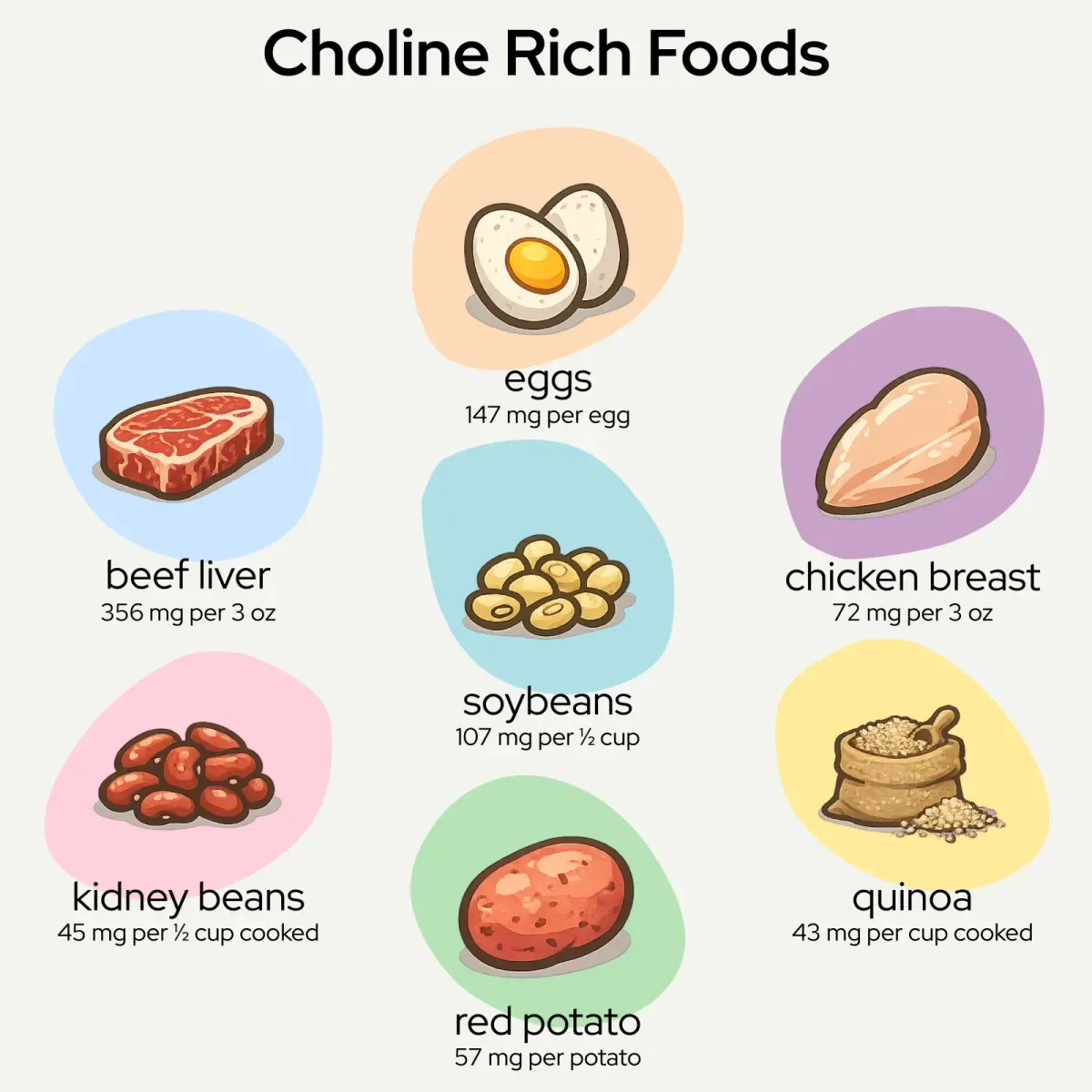
Most supplements only have 50mg of choline, which is why it is advised to prioritize getting choline through your meals. Below is a sample day of eating focusing on foods that are rich in choline.
- Breakfast: caprese omelette
- Lunch: moroccan beef and lentil soup
- Snack: cinnamon ginger energy balls
- Dinner: baked salmon with broccoli and quinoa
On days when you are not able to meet your targets for choline, it can be helpful to take a supplement.
If you want to learn more about how to adapt your diet and lifestyle during pregnancy to build the strongest and smartest baby, our team would be happy to guide you. Schedule a call with us to learn more.
References
- Derbyshire, E., & Obeid, R. (2020). Choline, neurological development and brain function: a systematic review focusing on the first 1000 days. Nutrients, 12(6), 1731. https://doi.org/10.3390/nu12061731
- Pregnancy Nutrition Guide by Precision Women’s Care.
- Nutrition in pregnancy: dietary requirements and supplements. UpToDate. https://www.uptodate.com/contents/nutrition-in-pregnancy-dietary-requirements-and-supplements
- Sam, C., & Bordoni, B. (2023). Physiology, acetylcholine. In StatPearls. StatPearls Publishing. https://www.ncbi.nlm.nih.gov/books/NBK557825/
- Zeisel, S. H. (2006). Choline: critical role during fetal development and dietary requirements in adults. Annual Review of Nutrition, 26, 229-250. https://doi.org/10.1146/annurev.nutr.26.061505.111156